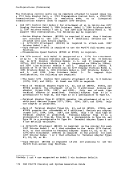
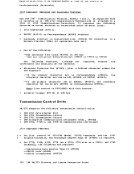
Multivolume files are read
End-of-volume is treated as
end-of-volume switching.
as single-volume
end-of-file. There User labels in user-labeled files are bypassed.
files.
is no Since DOS files do not contain BLKSIZE, RECFM, or LRECL
parameters, these parameters must be specified via FILEDEF or
DCB parameters; otherwise, defaults of BLOCKSIZE=32760 and are assigned. LRECL is not used for RECFM=U files. CMS does not support the use of OS/VS DUMMY VSAM data sets at
program execution time, since the CMS/DOS implementation of the DUMMY statement corresponds to the DOS/VS implementation.
Specifying the DUMMY option with the DLBL command will cause an
execution-time error.
7. Assembler program usage of VSAM and the ISAM Interface Program (lIP) is not supported. Miscellaneous Restrictions
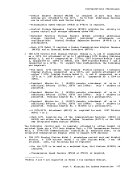
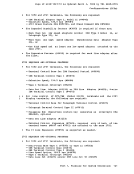
1. If you intend to run VM/370 Release 1 and pre-PLC 9 Release 2
systems alternately, apply Release 1 PLC 14 or higher (APAR Vl179) to your Release 1 system, to provide compatibility and to prevent
loss of spool files in case of a warm start. Changes to the spool
file format in PLC 9 of Release 2 require a cold start when
switching between pre-Release 2 PLC 9 and post-Release 2 PLC 9
systems.
2. The number of pages used for input/output must not exceed the total
number of user pages available in real storage. Violation of this
restriction causes the real computing system to be put into an
enabled wait state.
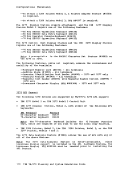
3. If you intend to define more than 64 virtual devices for a single
virtual machine, be aware that any single request for free storage
in excess of 512 doublewords (a full page) can cause an error
message to be issued if storage cannot be obtained. Tables for
virtual devices for a virtual machine must reside in contiguous
storage. Therefore, two contiguous pages of free storage must be
available in order to log on a virtual machine with more than 64
virtual devices, (three contiguous pages for a virtual machine with
more than 128 virtual devices, etc.). Contiguous pages of free
storage are sure to be available only immediately after IPL, before
other virtual machines have logged on. Therefore, a virtual
machine with more than 64 devices should be the first to log on
after IPL. The larger the real machine size, the lesser the
possibility of this occurring.
4. For remote 3270s, VM/370 supports a maximum of 16 binary
synchronous lines, minus the number of 3704/3705 Communications
Controllers in NCP mode minus one (if there are any 3704/3705 Communications Controllers in emulation mode).
5. If an I/O device (such as a disk or tape drive) drops ready status
while it is processing virtual I/O activity, any virtual machine
users performing I/O on that device are unable to continue
processing or to log off. Also, the LOGOFF and FORCE commands are
not effective because they do not complete until all outstanding I/O is finished. The system operator should determine which IIO device is involved and make that device ready once more. 440 IBM VM/370 Planning and System Generation Guide
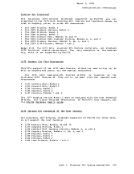
Page of GC20-1801-10 As Updated April 1, 1981 by TNL GN25-0837
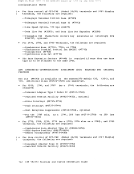
6. Any modifications to local OPTIONS COPIFILE, unless otherwise
specified in existing documentation, is not supported.
7. If an installation is using an IBM 3031, 3032, or 3033 processor,
it must dedicate the service record file (SRF) device to VK/370. Thus, the channel on which the SRF is located cannot be dedicated
to any virtual machine.
8. When using the SPOOL, DEDICATE, and SPECIAL directory control
statements to define virtual devices, specify virtual addresses
that do not conflict or content with the virtual control unit
interface. This conflict or contention occurs because devices can
require special I/O interface protocol from control units such as
shared and nonshared subchannel operations. Putting devices that
require different real control units on the same virtual control
unit can result in a hung or busy condition. To avoid this
problem, users must define (and separate) devices within their own
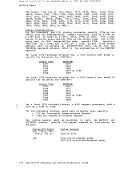
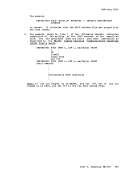
control unit range. For example, if the directory entry specifies: SPOOL 102 3211 SPECIAL 103 3270
The control unit 0 on channel 1 controls both a nonshared device
(the 3211 printer) and a shared device (the 3270 display unit).
Processing of channel programs involving these two devices can
result in a hung or busy condition.
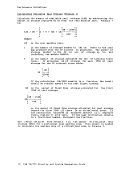
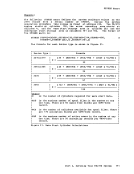
9. The number of virtual devices for a virtual machine cannot exceed
the value determined by (7FFF/VDEVSIZE), where VDEVSIZE is the size
of the VDEVBLOK. If a greater number of virtual devices is
specified, results may be undesirable.
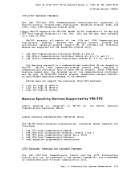
10. programs developed using CMS/DOS may not be transferable directly
to a DOS machine. The following considerations should be kept in
mind: The CMS/DOS linkage editor is designed to linkedit DOS programs
for execution under eMS/DOS only. Programs transferred to a DOS machine should be re-link edited under DOS. Programs assembled using CMS assembler may have incorrect ESDs. This is because the CMS assembler is not compatible with the DOS assembler. Programs transferred to a DOS machine should
therefore be re-assembled under DOS. Appendix F: VM/370 Restrictions 441
Previous Page Next Page